Cooking with gnuplot

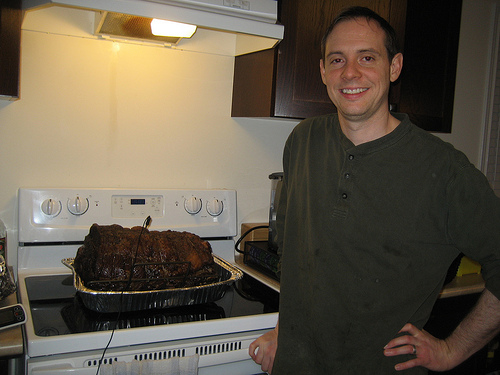
Over the winter holidays I was put in charge of cooking one (of several) of the family dinners. At my house, a Christmas dinner can mean only one thing: prime rib is on the menu. The local grocery store had a great deal on rib roasts, so I bought a whole one. All seven ribs, 25 pounds of it. When it came time to cook this beast, I did plenty of reading, and settled on this seriouseats recipe. I guessed at about six hours to slow-roast the behemoth. But after a few hours of roasting, I decided it would be nice to know whether it would finish in time for the guests, or whether we would have to invent some pre-meal activities to stall.

Linear regression to the rescue! I had a leave-in meat thermometer plugged into the slab of cow, the type with a cable that runs outside the oven so that you can read the temperature without opening the oven door. It was then a simple matter to record the temperature every fifteen minutes and plot it to see how it was going. My uninformed guess was that the temperature curve is really sigmoid-shaped, but linearity is probably close enough around the target range.

Gnuplot can do linear regression for you:

f(x) = a*x + b
fit f(x) 'temp.dat' u 1:2 via a, b
set xrange [-5:160]
plot 'temp.dat' u 1:2 w linespoints, f(x)

This produces a graph like the image below, which shows that after 3 hours of cooking, the meat would be around 128 degrees (I started keeping track about three hours in).

In the end, I turned up the oven a bit in the last hour to speed things along. The meat turned out great, although I didn’t have too much luck with the in-between rest that the recipe promotes: there were still plenty of juices all over the place at carving time. Next time, I believe I’ll just turn the oven up to 500 deg. F when the interior target temperature is reached, and then do a normal rest afterwards. Another lesson learned: a full rib roast is perhaps twice as much as needed for eight people, but I am not one to complain about having prime rib leftovers for a week.

Blowtorch Cuisine

Ever mindful of fire safety, I’ve had a full propane canister (the small blowtorch size) rattling around in the back of my trunk for two and a half years. Luckily our car never decided to explode, but just in case, I’ve decided to finally use up the fuel.

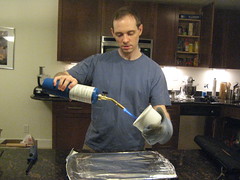
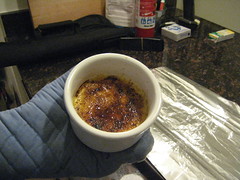
Since I plan to never do any sort of plumbing again, the natural application for my blowtorch flame is on food, specifically crème brûlée. So I baked up some custard in my soup bowls, tossed some sugar on top, and burnt that bad boy.

burn

The problem is these torches really only work well upright, so you wind up having to bring the food to the flame rather than the other way around. I did at least have my fire extinguisher at the ready in case a wall decided to ignite. The smoke detector only went off once.

burnt

Our tasters were split on the outcome. Ange really liked it. I thought the custard was a bit too eggy, but that could be the recipe or personal taste. As I’m not a big CB eater, I don’t really have much to compare it to. It looked good, though.

Next up, fire grilled cheese?

Pork

Inspired by the ‘tinga’ (Mexican roast pork tostadas) recipe in this month’s Cook’s Illustrated, I bought a $12 picnic shoulder at the grocery store on our last trip out. The recipe recommends a boneless boston butt instead, which is probably a good idea given all of the tendons in the lower cut. But my grocer only had the shoulder and it’s cheap so what the heck.

I spent last Saturday morning carving all of the meat off of the bone, at which point I realized just how much pig we’re going to be eating for the next few weeks. As Ange and I try to subscribe to the ‘use everything but the squeal’ philosophy, I portioned the slab for various future meals: two pounds of meat for the aforementioned tinga, a couple of pounds cut into thin slabs for char siu, about another pound or so of trimmings for barbecue or pork tacos, and the bones went into the freezer for congee.

Which left a big hunk of skin. I tried making cracklings out of this, but the porcine gods were not having it: it was a big sticky mess. I ultimately gave up after a one sizzling piece of skin and lard hopped out of the pan only to land on my face about a centimeter away from my right eye. Even fried pig skin isn’t worth blindness.

The tostadas were pretty awesome though.

Hummus

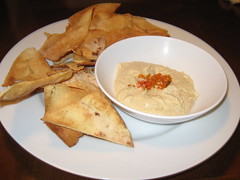
HummusAnge and I have been on a real Hummus kick lately for some reason. A container of Sabra is usually gone within a few minutes of being opened around here. So I decided to save a few trips to the store and try making it at home. Turns out, this is really easy: dump a can of chick peas, 1/4 c each of olive oil, water, and tahini (finding this is the hard part), a garlic clove and 1-2 tbsp of vinegar into the food processor, and press “On.” A little time spent chilling in the fridge and it’s good to go. A couple of roasted habaneros wouldn’t be a bad addition, either.

I also made my own pita chips from pita bread. While tasty and a lot cheaper than pre-made chips, I think that is far too much work when you’re hungry.

Sausage fest

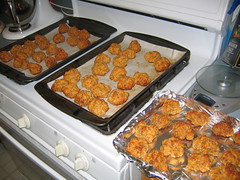
5000 Calories of AwesomeWhenever I have some occasion at which I am to provide a side item or hors d’œuvres, I consider making the quintessential party treat: sausage balls. I think these are a Southern US mainstay, as no one around here seems to have encountered them before, whereas in my youth they made an all-too-brief appearance at many a gathering. Take it from me and my waistline, these things are full of win.

The classic recipe goes like this:

2 c Bisquick brand baking mix
10 oz medium chedder cheese, grated*
1 lb breakfast sausage**

* Sharp tends to be too dry. I also freshly grate it with the food processor since block cheese usually has more moisture than packaged grated cheese.
** Jimmy Dean “Hot”. Spicier is better.

Preheat oven to 350°. Mix everything together with your hands until it forms one big lump. Roll into 1.5-2″ diameter balls. Place on a cookie sheet and bake for 20 minutes or until golden brown. Cool before serving.

It doesn’t get much easier than that. However, I’m not crazy about relying on Bisquick; if we ever buy it, it stays in our fridge forever. I make biscuits frequently, but I find Bisquick biscuits to have a very chemical, baking soda taste that reminds me of pancakes. Maybe because I’m too lazy to make pancakes from scratch, so if I ever do, I use Bisquick — guess how often we have pancakes.

Anyway, I always have the components for home-made biscuits on hand, so I thought I would make an extra batch without Bisquick and see how it went. I took my normal biscuit recipe (stolen from Alton Brown), replaced the butter with shortening, as I thought the butter would make it too greasy, and supplanted the Bisquick:

2 c flour
4 tsp baking powder
3/4 tsp salt
1/4 tsp baking soda
4 tbsp buttermilk mix (my one cheat with biscuits, but it works great)
4 tbsp vegetable shortening
1.5 tbsp water
[rest same as above]

As indicated, I added a little water, because I found the Bisquick mixture to be a bit more moist than the flour mixture (I guess it has a little more fat in it). If the mixture is too dry, the ingredients will crumble rather than form a cohesive whole.

The result? The cheese and sausage really overwhelm the flavor of the dough, so there’s not much difference in taste. In texture, the Bisquick balls are chewier, while the from-scratch version is a bit lighter. It’s rather subtle, so while I somewhat prefer the latter, it’s not generally worth the extra effort. But since it saves me from buying biscuit mix, it’s a winner in my book.

Next time, I’ll try using chorizo.

Berlin eats

Ange and I are back in the States after our wonderful break abroad. Now we’re home again, delighting in such missed American excesses as air conditioning, queen-sized beds, and monolingualism. The latter, actually, is our biggest regret of the trip: the next time we visit a country we’ll have to plan ahead and take a few language courses. Even so, we picked up the basics during our immersion, achieving a fluency on par with, say, a one-year-old who takes the subway a lot.

Our first exposure to Berlin cuisine was at a coffee house where we had a few of the sweet pastries that give the city its name, if I interpret that old JFK myth correctly. Jelly doughnuts, doughnuts shaped like pretzels, strudels, cheesecakes, cheese pastries, and so on were also amply supplied gratis at our hotel, so snarfing down on cakes with tea on the patio quickly became an afternoon tradition during the trip.

For street food, the main contenders seem to be all sorts of sausages, especially the currywurst preparation, and the döner kebab. Currywurst is essentially a sausage sprinkled with curry powder and doused in ketchup. It’s very good — any sausage in Berlin is about 50 times better than the brats one can get at home, though neither of us were really sold on the necessity of the curry powder. Not bad, just different. The döner kebab is more or less a gyro served in a spongy, focaccia-like pita, slammed with enough meat and vegetables to make holding it nearly impossible. I miss them already.

Our best dinner in a standard restaurant was at Florian, a German/Austrian restaurant around the corner from our hotel. The selection was game-influenced: Angeline had duck and I had a roast pig, all served with a hearty gravy and various starches. Both dishes were excellent; you can’t go wrong with roasted animals.

However, the culinary highlight of our trip was with the so-called “Shy Chef,” an underground restaurant. Our friends turned us onto this by sending us a story by Gisela Williams in a little-known rag, The New York Times. We were fortunate enough to grab a reservation the week after the story ran.

The evening before dinner, we got the email leading us to the restaurant’s secret location. Upon arriving, we found our way into a small Berlin flat with a table set for four. The proprietors are obvious bibliophiles, as is instantly inferred from the books spilling out of wall-length, floor-to-ceiling bookcases, and underscored by the Papa-inspired absinthe cocktails handed to us as soon as we entered the room. (As an aside, if number of bookstores is any indication, Germans are enthusiastic readers. We passed three independent bookstores every morning during the 50 meter walk to our nearby café. A far cry from our highly polished, soul-starved Borders and B&Ns.)

The hidden supper club is a wonderful concept: it’s very much like a dinner party with friends, only you don’t know your friends until you get there. The fare is as good as in any restaurant, but the authenticity and intimacy are unmatched. Our fellow diners hailed from NYC and Oxford and made for excellent company, as did our hosts.

I won’t go into too much detail of the menu, lest it lose some of the mystique, but the highlights for me were a velvety garlic-cauliflower purée with an inventive parmagiano reggiano “gratin”; thin-sliced salmon in olive oil with German bleu cheese, apple and cucumber matchsticks; and a very nice salty, paper-thin ham that recalled to me the country ham my Tennessean relatives cured themselves. The dishes were accompanied by generous wine pairings, together more wine than Angeline and I have had in the previous year or so, but all of them excellent choices. As the gentleman from Oxford said, the entire experience was “just brilliant,” and I am sure we’ll remember this dinner for quite some time.
That refreshing Georgia spirit

The Spirit of GeorgiaOne of our guidebooks claimed that while Coca-cola was ever present, Berliners drink their own local soft drinks. We haven’t found that to be the case; it seems only Coke products are here. Of course there are minor differences: regular Coke is made with sugar, Diet Coke (called “Coke light” here) has saccharine. Then there’s the stuff you can’t get back home (outside of World of Coke), such as “Mezzo Mix” which is essentially Coke with orange. I found this one, “The Spirit of Georgia” our first day here. Despite many years living in Georgia, I was not quite sure what our collective spirit was, but now I know it is yellow-tinted Sprite.

Komi

I suppose it’s a bit bourgeois to go to really expensive restaurants while the economy is crashing down around us. But Angeline’s birthday arrived last week, and it has been hard to resist the siren song of Komi from all the positive things we’ve heard. So off we went to Johnny Monis’ fancy greek restaurant last Friday night.

As we tend to do in the high end places, we went with the degustazione, the tasting menu. Angeline ordered a crisp glass of white wine, and I signed up for the three glass pairing. (Not being a wine connoisseur, I couldn’t really say whether the pairing was good or bad. The sommelier didn’t spend a lot of time explaining the choices, and there was nothing revelatory about the choices from my point of view. At any rate, that hardly put a damper on the meal.) The tasting menu begins with an almost unending parade of small plates, they call mezzethakia (actually if you google “mezzethakia,” you’ll get much better reviews of Komi right off the bat). Initial courses were primarily seafood: sashimi ahi in olive oil with salt and chives, sea urchin and oyster in a fruity gel, a salad with baby octopus tentacles, a really nice ceviche with sweet pine nuts (I forget the fish, salmon perhaps?), and scallop carpaccio with truffle mayonnaise. A steak tartare with white truffle ice cream soon followed. And finally, on a plate with tiny foie gras sandwiches, handmade animal crackers, and goat cheese smores, was a date stuffed with mascarpone cheese, sprinkled with fluer de sel. It may not sound like much, but this last, one of the most talked-about items from his restaurant, was excellent and well worth the hype.

For pasta, I had a tagliatelle, I think, while Ange had pumpkin ravioli that were amazing. Then they brought the “salad” course: a one inch crouton, deep fried with a caesar salad puree inside. Very imaginative, and it did taste just like a tiny caesar salad.

The small portions gave way for a massive katsikaki (slow roasted goat shoulder). This was very good: coated in artisanal salt, the outside was crisp and flavorful, a bit like roasted chicken skin, while the inside was fork tender, like a less-fatty pork barbecue. It was served with an array of home-made condiments. Dessert included various chocolate presentations (a mousse and a small cake, if I recall correctly) and some tasty greek donuts. The bill came with home-made almond lollipops, presumably to distract from the number of digits in the total.

Bottom line: definitely top three restaurants I’ve been to, top one or two in DC. Well worth eating PB&J for a month to save up the cash.