While stuck inside for days due to snow, I once again downloaded the Android source trees from the repos. I plan to update my Android wifi page with better, step-by-step instructions to go from nothing to a working set of wireless utilities on the phone. In the meantime, I’ve re-familiarized myself with the current Android build environment (for various values of current — this uses donut since as far as I know, eclair doesn’t have a definition for the Dream (G1/ADP1) phone yet).
I do have to say that things in this area have improved a lot. While it still took some google-fu to figure out which branch to check out to get the correct software (tag donut-plus-aosp), buildling the entire image from scratch was rather straightforward (. build/envsetup.sh; lunch aosp_dream_us-eng; make). My main complaint is that the build system is far too slow to use for day-to-day work. Is Google still not eating their dogfood here?
So far I have libnl, iw, and packetspammer now integrated properly via Android.mk makefiles, and a custom kernel plus the support modules for wl1251. Unfortunately, space is really tight on the system partition, so the TI driver had to go to make room for everything. I’m still waiting for someone to port the Android runtime to emdebian or maemo with /usr on the sdcard, but perhaps I’ll mess around with bind mounts until then.
It seems wl1251 SDIO doesn’t like the new power-saving code, so that is something else I’ll look into soon. For now, one can disable that in the driver or possibly via “iwconfig power off”.
wl1251: cmd set ps mode
wl1251: cmd configure
mmc0: Data timeout
wl1251: ERROR sdio write failed (-110)
...
wl1251: ERROR elp wakeup timeout

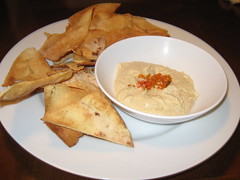 Ange and I have been on a real Hummus kick lately for some reason. A container of Sabra is usually gone within a few minutes of being opened around here. So I decided to save a few trips to the store and try making it at home. Turns out, this is really easy: dump a can of chick peas, 1/4 c each of olive oil, water, and tahini (finding this is the hard part), a garlic clove and 1-2 tbsp of vinegar into the food processor, and press “On.” A little time spent chilling in the fridge and it’s good to go. A couple of roasted habaneros wouldn’t be a bad addition, either.